
Business success rarely happens by accident. Behind sustainable growth, confident decision-making and strong operational performance is usually a clear plan that connects business ambitions with practical action.
Whether you are launching a new company, expanding an established organisation or improving existing operations, business success planning provides the direction needed to move forward with purpose.
Without a structured strategy, businesses can become reactive. Resources may be allocated inefficiently, opportunities may be overlooked and important decisions may be made without sufficient information.
A well-developed business roadmap helps organisations identify priorities, evaluate opportunities, manage risks and measure progress towards meaningful objectives.
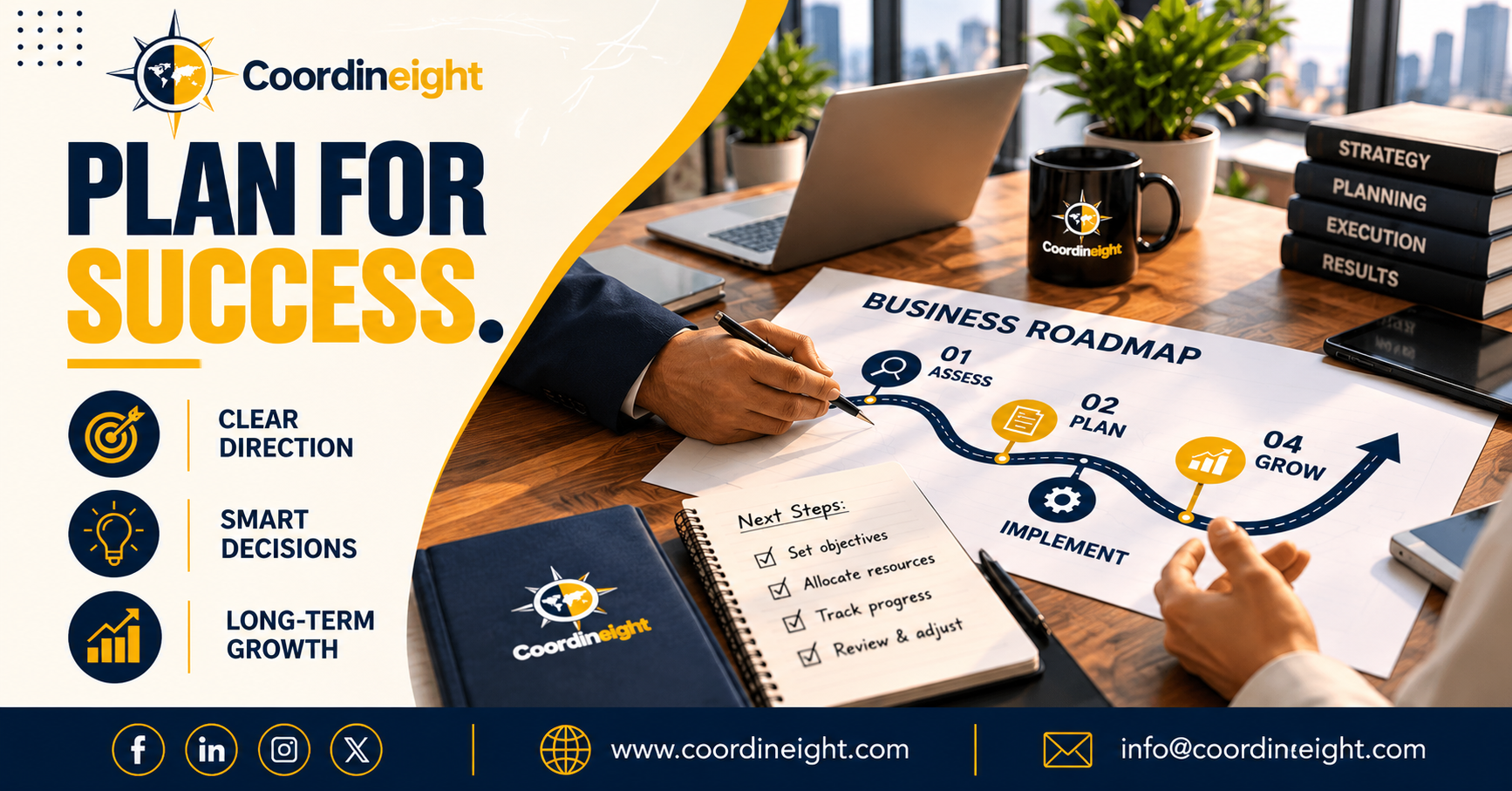
At Coordineight, the message is simple: Plan for Success. Clear direction, smart decisions and a commitment to long-term growth form the foundation of a stronger business.
This guide explores how to develop an effective business strategy, create a practical roadmap and turn long-term ambitions into measurable results.
What Is Business Success Planning?
Business success planning is the process of defining organisational objectives and developing a structured approach to achieving them.
It involves understanding the current position of a business, identifying desired outcomes and determining the actions, resources and decisions required to make progress.
An effective business plan goes beyond financial projections or general statements about future ambitions.
It should connect several important areas:
- Business vision: What the organisation wants to achieve over time.
- Strategic objectives: The specific outcomes that support that vision.
- Market understanding: Customer needs, industry conditions and competitive opportunities.
- Resource allocation: How finances, people, technology and time will be used.
- Operational planning: The activities required to deliver business objectives.
- Performance measurement: How progress and results will be evaluated.
- Risk management: How potential obstacles will be identified and addressed.
Together, these elements create a framework for informed decision-making.
Business success planning is not a one-time exercise. It should evolve as market conditions, customer expectations and organisational priorities change.
Why Strategic Business Planning Matters
A business may have excellent products, capable employees and promising opportunities, yet still struggle without clear priorities.
Strategic planning helps organisations connect everyday activities with broader business goals.
1. Provides Clear Business Direction
Clear direction allows employees and managers to understand what the organisation is working towards.
When priorities are defined, teams can focus on activities that contribute directly to business objectives.
For example, a company aiming to improve customer retention may prioritise service quality, communication and customer relationship management rather than focusing exclusively on acquiring new customers.
A clear strategy helps prevent resources from being spread across unrelated initiatives.
2. Supports Smarter Business Decisions
Every business faces decisions involving investment, staffing, pricing, technology and market opportunities.
Strategic planning provides a framework for evaluating these choices.
Instead of reacting to immediate pressure, management can consider how each decision affects long-term objectives.
This does not eliminate uncertainty, but it encourages a more structured approach.
3. Improves Resource Management
Financial resources, employee capacity and management time are limited.
Planning helps organisations identify where these resources are most likely to create value.
It can also highlight activities that consume resources without contributing meaningfully to business performance.
4. Encourages Sustainable Growth
Growth can introduce new operational challenges.
A business that expands without sufficient planning may experience cash flow pressure, inconsistent service quality or inefficient processes.
Strategic planning helps organisations evaluate whether they have the capacity and resources to support expansion.
Step 1: Assess Your Current Business Position
Before developing a roadmap for future success, businesses need an accurate understanding of their present situation.
This assessment provides the foundation for realistic objectives and informed decisions.
Evaluate Financial Performance
Review important financial information, including revenue, profitability, cash flow and operating expenses.
Consider whether existing financial resources are sufficient to support planned activities.
Businesses should also examine revenue concentration, outstanding payments and potential financial vulnerabilities.
A clear financial picture helps management identify opportunities and constraints.
Review Operational Performance
Evaluate how efficiently the organisation delivers its products or services.
Look for recurring delays, unnecessary administrative work, quality issues and communication problems.
Questions worth asking include:
- Which business processes work effectively?
- Where do delays or errors occur?
- Are employees equipped with suitable tools?
- Are responsibilities clearly defined?
- Which activities create the greatest customer value?
The objective is to identify operational strengths and areas requiring improvement.
Understand Your Market Position
Examine your target audience, competitors and customer expectations.
Consider why customers choose your business and whether your value proposition remains relevant.
Customer feedback, sales information and competitor research can provide useful insights.
Step 2: Use SWOT Analysis to Identify Opportunities
A SWOT analysis is a practical tool for evaluating internal and external factors affecting business performance.
SWOT stands for Strengths, Weaknesses, Opportunities and Threats.
Strengths
Strengths are internal advantages that support business performance.
Examples may include experienced employees, strong customer relationships, specialist expertise or efficient operational processes.
Weaknesses
Weaknesses are internal limitations that may restrict progress.
These could include outdated systems, limited financial resources, inconsistent processes or gaps in employee capabilities.
Opportunities
Opportunities are external conditions that may create potential for growth or improvement.
Examples include emerging customer needs, technological developments, new markets or changes in purchasing behaviour.
Threats
Threats are external factors that could negatively affect business performance.
These may include increasing competition, economic uncertainty, supplier disruption or regulatory changes.
Turning SWOT Findings Into Action
A SWOT analysis becomes valuable when its findings influence actual decisions.
For example, a business with strong customer relationships but limited digital visibility might prioritise improving its online presence.
Similarly, an organisation facing supplier-related risks may explore alternative sourcing arrangements.
The aim is not simply to complete an analysis but to identify practical strategic priorities.
Step 3: Set Clear and Measurable Business Goals
Business goals provide direction, but vague ambitions are difficult to manage.
Statements such as “increase sales” or “improve efficiency” do not explain what success looks like or how progress will be assessed.
Effective objectives should be specific and measurable.
Apply the SMART Goal Framework
SMART goals are:
- Specific: Clearly describe the desired outcome.
- Measurable: Include a method for evaluating progress.
- Achievable: Reflect realistic capabilities and resources.
- Relevant: Support wider business priorities.
- Time-bound: Establish an appropriate deadline.
For example, instead of setting a goal to improve customer service, a business might aim to reduce its average response time by 20% over six months while maintaining customer satisfaction.
This provides a clearer basis for planning and evaluation.
Separate Short-Term and Long-Term Objectives
Short-term goals typically focus on immediate improvements or activities.
These may include updating operational procedures, improving reporting systems or completing employee training.
Long-term goals may involve entering new markets, expanding capacity or strengthening profitability.
Both types of objectives should support the same strategic direction.
Prioritise Your Goals
Trying to pursue too many objectives simultaneously can reduce effectiveness.
Businesses should assess each goal according to its potential impact, urgency, cost and resource requirements.
Prioritising a manageable number of objectives helps teams maintain focus.
Step 4: Develop a Practical Business Roadmap
A business roadmap translates strategic objectives into a sequence of activities.
It explains what needs to happen, who is responsible and how progress will be measured.
A useful roadmap should be detailed enough to guide action without becoming unnecessarily complicated.
The Four Stages of a Business Roadmap
1. Assess
Understand the organisation’s current position, capabilities and challenges.
Review financial performance, operational processes, market conditions and customer needs.
2. Plan
Define objectives, identify priorities and determine the resources required.
Establish realistic timelines and assign responsibilities.
3. Implement
Put the planned activities into practice.
Communicate expectations, provide necessary resources and coordinate work between relevant teams.
4. Grow
Evaluate outcomes, identify successful improvements and consider opportunities for sustainable expansion.
Growth should be supported by reliable performance information and operational readiness.
Example of a Business Roadmap
| Stage | Key Activity | Intended Outcome |
|---|---|---|
| Assess | Review business performance | Identify priorities |
| Plan | Set measurable objectives | Establish clear direction |
| Implement | Execute improvement activities | Deliver planned changes |
| Review | Measure results and address gaps | Improve performance |
| Grow | Evaluate expansion opportunities | Support sustainable growth |
A roadmap should be reviewed regularly to ensure it remains relevant.
Step 5: Make Smarter Decisions Using Business Data
Effective business decisions combine reliable information, professional judgement and a clear understanding of organisational priorities.
Although experience and intuition can be valuable, important decisions should not depend exclusively on assumptions.
Identify Relevant Business Data
Useful information may include:
- Revenue and profitability trends.
- Customer acquisition and retention.
- Operational costs.
- Employee productivity.
- Customer feedback.
- Market demand.
- Inventory and resource utilisation.
- Marketing performance.
The most relevant information depends on the business and the decision being considered.
Evaluate Alternatives
Before committing to a major decision, consider the available options.
For example, a business planning to increase operational capacity might compare hiring additional employees, improving existing processes and introducing suitable technology.
Each option should be evaluated according to expected benefits, costs, risks and implementation requirements.
Avoid Common Decision-Making Mistakes
Businesses should be cautious about:
- Making decisions without sufficient information.
- Relying on outdated financial data.
- Ignoring customer feedback.
- Overestimating expected benefits.
- Underestimating implementation costs.
- Failing to consider alternative solutions.
A structured decision-making process helps reduce avoidable mistakes.
Step 6: Allocate Resources Effectively
Even a strong business strategy can fail when the organisation lacks the resources required to implement it.
Resource planning involves determining how finances, employees, technology and management time will support strategic objectives.
Financial Resource Planning
Prepare budgets that reflect realistic income expectations and planned expenditure.
Consider both initial implementation costs and ongoing operating expenses.
Businesses should also maintain appropriate financial flexibility to respond to unexpected circumstances.
Workforce Planning
Evaluate whether employees have the skills, capacity and support needed to deliver planned activities.
If new capabilities are required, consider training, recruitment or changes to existing responsibilities.
Technology and Infrastructure
Assess whether current systems can support the organisation’s objectives.
Technology investments should address genuine business needs and offer a reasonable expectation of operational value.
Time Management
Strategic projects often compete with daily operational responsibilities.
Establish realistic timelines and ensure that employees have sufficient capacity to complete assigned activities.
Step 7: Turn Business Strategy Into Action
Developing a business plan is only the beginning.
The real value comes from implementing it effectively.
Execution requires coordination, accountability and consistent communication.
Assign Clear Responsibilities
Every important activity should have an accountable owner.
Employees should understand their responsibilities, deadlines and expected outcomes.
Unclear ownership can lead to duplicated work or missed tasks.
Establish Implementation Milestones
Break larger projects into manageable stages.
For example, introducing a new customer management system might involve selecting a platform, preparing data, training employees and reviewing initial performance.
Milestones make progress easier to monitor.
Communicate the Strategy
Employees are more likely to contribute effectively when they understand the purpose behind planned changes.
Explain how strategic objectives relate to their responsibilities and the organisation’s wider goals.
Encourage questions and constructive feedback throughout implementation.
Address Problems Early
Implementation rarely proceeds exactly as expected.
Businesses may encounter delays, resource constraints or unexpected technical issues.
Regular progress reviews help identify problems before they become more difficult to resolve.
Step 8: Measure Business Performance With Relevant KPIs
Key performance indicators, or KPIs, help businesses assess whether their strategies are producing the intended results.
The right KPIs depend on organisational priorities.
Financial Performance Indicators
Common measures include revenue growth, gross profit margin, operating profit and cash flow.
These indicators help management understand financial performance and sustainability.
Customer Performance Indicators
Businesses may monitor customer satisfaction, retention, repeat purchases and customer acquisition costs.
These measures provide insight into customer relationships and marketing effectiveness.
Operational Performance Indicators
Relevant measures may include processing times, error rates, productivity and resource utilisation.
They can help identify opportunities to improve efficiency.
Employee Performance and Development
Organisations may review training participation, employee turnover and relevant productivity measures.
These indicators should be interpreted alongside employee feedback and working conditions.
Review KPIs in Context
Performance indicators should not be considered in isolation.
For example, increasing revenue may appear positive, but the improvement may be less valuable if costs rise faster than sales.
Regular reviews help management understand the wider picture.
Step 9: Manage Business Risks and Uncertainty
Every business strategy involves uncertainty.
Market conditions, customer expectations, operational requirements and financial circumstances can change.
Risk management helps organisations prepare for potential disruption.
Identify Key Business Risks
Consider risks relating to:
- Financial stability.
- Customer demand.
- Supplier reliability.
- Technology and cybersecurity.
- Employee availability.
- Operational continuity.
- Regulatory requirements.
- Market competition.
The significance of each risk will depend on the organisation.
Assess Likelihood and Impact
Evaluate how likely each risk is to occur and how seriously it could affect business objectives.
High-impact risks may require additional monitoring and contingency arrangements.
Develop Contingency Plans
Contingency planning helps businesses prepare appropriate responses.
For example, an organisation dependent on a single supplier may consider alternative suppliers or suitable inventory arrangements.
A business relying heavily on one customer segment may investigate opportunities to diversify revenue.
The objective is not to eliminate every risk but to improve organisational resilience.
Step 10: Build a Strategy for Sustainable Business Growth
Long-term business growth requires more than increasing sales.
Organisations must also maintain financial stability, operational quality and the ability to meet customer expectations.
Focus on Profitable Growth
Increasing revenue does not necessarily improve profitability.
Businesses should evaluate the costs associated with acquiring customers, expanding operations and delivering products or services.
Growth initiatives should be assessed according to their potential contribution to long-term financial performance.
Strengthen Customer Relationships
Customer retention can support business stability and provide valuable feedback for improvement.
Businesses should focus on consistent service, clear communication and understanding customer needs.
Improve Operational Scalability
As demand increases, existing systems and processes may become less effective.
Businesses should identify capacity constraints and consider improvements before they create significant disruption.
Encourage Continuous Innovation
Innovation does not always require major technological investment.
It may involve simplifying a process, improving a service or finding a more effective way to meet customer needs.
A culture of continuous improvement helps organisations adapt to changing circumstances.
Common Business Planning Mistakes to Avoid
Even experienced organisations can encounter difficulties when developing and implementing strategic plans.
Setting Unrealistic Objectives
Overly ambitious goals can place unnecessary pressure on resources.
Objectives should challenge the organisation while remaining grounded in realistic assumptions.
Failing to Involve Employees
Employees often have practical knowledge of operational challenges.
Excluding relevant teams from planning can result in missed information and implementation difficulties.
Ignoring Financial Constraints
A strategy that lacks adequate financial support may be difficult to execute.
Budgets and cash flow forecasts should be considered before major commitments are made.
Creating Plans Without Accountability
Strategies require clear responsibilities and regular progress monitoring.
Without accountability, important activities may remain incomplete.
Refusing to Adjust the Plan
Business conditions change.
An effective strategy should provide direction while allowing appropriate adjustments when new information becomes available.
How Often Should Businesses Review Their Strategic Plans?
Strategic planning should be an ongoing management activity.
The appropriate review frequency depends on the organisation’s size, industry and operating environment.
A practical approach may include:
Weekly or fortnightly reviews: Monitor immediate priorities, project milestones and operational issues.
Monthly reviews: Evaluate key performance indicators, financial results and implementation progress.
Quarterly reviews: Assess strategic priorities, resource allocation and changing market conditions.
Annual reviews: Reconsider long-term objectives, business direction and major investment priorities.
Businesses operating in rapidly changing environments may need more frequent reviews.
The purpose of reviewing a plan is not simply to confirm that activities have been completed. It is to determine whether the strategy remains effective.
Why Clear Direction and Smart Decisions Create Long-Term Value
Clear direction helps businesses understand what they want to achieve.
Smart decisions determine how resources and opportunities are used to support those ambitions.
Long-term growth becomes more achievable when these elements work together.
A business with clear objectives but poor execution may struggle to make progress.
Similarly, an organisation that makes effective short-term decisions without a wider strategy may find it difficult to maintain a consistent direction.
Successful planning connects vision, decision-making and implementation.
It also recognises that business performance depends on continuous learning.
Organisations should use both successes and setbacks to improve future decisions.
Coordineight: Planning for a Stronger Business Future
The Coordineight Plan for Success message highlights three principles that can support organisations at different stages of development.
Clear Direction
Understanding business priorities and establishing measurable objectives provides a foundation for focused action.
Smart Decisions
Using reliable information, evaluating alternatives and considering long-term consequences helps organisations make more informed choices.
Long-Term Growth
Sustainable development requires financial discipline, operational readiness and a commitment to continuous improvement.
Together, these principles demonstrate why effective planning is essential for building a resilient organisation.
Conclusion: Plan Today for Business Success Tomorrow
Business success planning provides the structure needed to turn ideas into practical action and long-term ambitions into measurable objectives.
By assessing current performance, establishing clear goals, developing a business roadmap and monitoring results, organisations can improve their ability to make informed decisions.
A successful strategy should remain realistic, flexible and connected to the needs of customers, employees and the wider business.
At Coordineight, the Plan for Success message reinforces an important idea: clear direction, smart decisions and long-term growth begin with purposeful planning.
Whether you are reviewing your current strategy or preparing for the next stage of business development, the first step is understanding where you are, where you want to go and what it will take to get there.
Ready to start planning for a stronger business future?
Visit www.coordineight.com to explore Coordineight, or contact info@coordineight.com to continue the conversation.
Plan with purpose. Make smarter decisions. Build towards lasting success.