
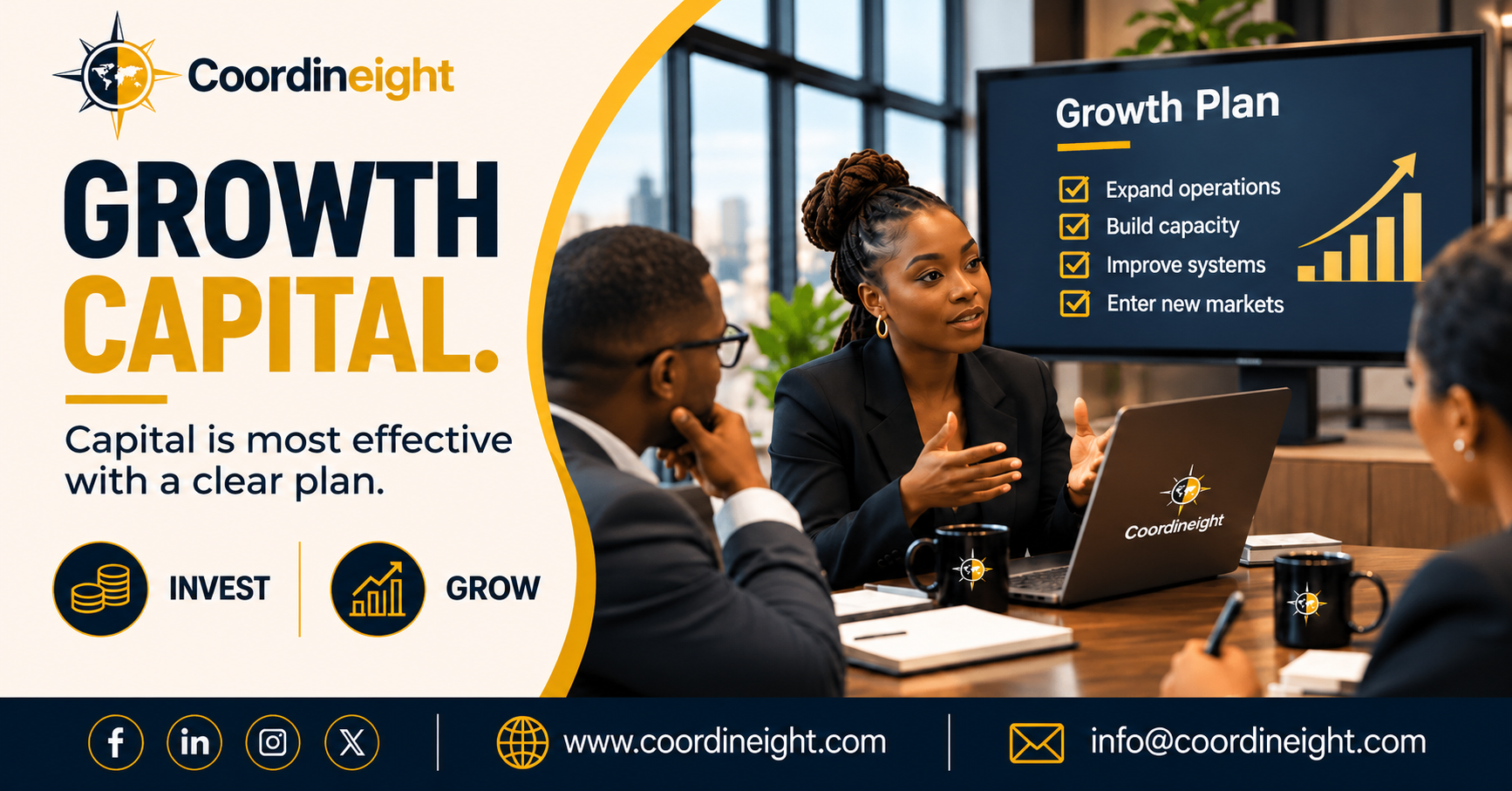
Access to capital can create exciting opportunities for a growing business. Whether the goal is to expand operations, recruit talented employees, invest in technology or enter new markets, additional funding can provide the resources needed to move forward.
However, securing investment is only one part of the equation. The real value of growth capital depends on how effectively it is planned, allocated and managed.
Businesses that invest without clear objectives risk increasing costs, stretching resources and creating financial pressures that undermine their original ambitions. By contrast, organisations that approach investment strategically are better positioned to make informed decisions, strengthen their operations and pursue sustainable growth.
This is the central message behind Coordineight’s Growth Capital campaign:
Capital is most effective with a clear plan.
In this guide, we explore what growth capital means, how businesses can use it effectively, the importance of financial planning and the practical steps leaders can take to turn investment into measurable business progress.
What Is Growth Capital?
Growth capital refers to funding used by an established or developing business to support expansion, strengthen its capabilities or pursue new commercial opportunities.
Unlike funding intended primarily to cover immediate financial difficulties, growth capital is generally directed towards activities expected to improve future business performance.
These investments may include:
- Expanding business operations or production capacity.
- Recruiting employees with specialist skills.
- Purchasing equipment, machinery or technology.
- Developing new products or services.
- Entering additional geographical markets.
- Improving operational systems and infrastructure.
- Strengthening marketing and customer acquisition.
- Increasing working capital to support higher sales volumes.
The appropriate use of growth capital depends on the organisation’s business model, financial position, industry and strategic priorities.
For example, a manufacturing company may require capital to increase production capacity, while a professional services business may prioritise recruitment, technology and business development.
In both cases, successful investment begins with understanding exactly what the business wants to achieve.
Why Growth Capital Needs a Clear Business Plan
Additional funding can accelerate progress, but it can also magnify existing operational weaknesses.
If a business lacks clear priorities, introducing more capital may result in spending that delivers limited long-term value.
A structured growth plan helps leaders evaluate opportunities before committing resources.
1. Establishing Clear Business Objectives
Before seeking or allocating capital, businesses should define their intended outcomes.
Objectives might include increasing production capacity, improving profitability, expanding into a new market or reducing operational inefficiencies.
A useful objective should be specific enough to guide decisions and measurable enough to evaluate progress.
For example, rather than simply aiming to grow sales, a business could establish a target for increasing revenue within a defined period while maintaining an acceptable profit margin.
2. Identifying Investment Priorities
Businesses frequently have more potential investment opportunities than available resources.
A growth plan helps determine which projects are most closely aligned with strategic objectives.
Investment priorities should reflect expected benefits, implementation requirements, financial risks and organisational capacity.
3. Improving Financial Decision-Making
Financial planning allows businesses to assess whether proposed investments are commercially realistic.
This includes reviewing cash flow, expected returns, ongoing costs and the time required for an investment to generate benefits.
4. Managing Risk
Every investment involves uncertainty.
A structured plan encourages businesses to consider potential setbacks and develop appropriate contingency measures.
5. Measuring Performance
Without defined success measures, it becomes difficult to determine whether capital has been used effectively.
Clear performance indicators allow leaders to evaluate results and adjust their strategy when necessary.
The Difference Between Growth Capital and Working Capital
Growth capital and working capital are related but serve different financial purposes.
Understanding this distinction helps businesses make more appropriate funding decisions.
Growth Capital
Growth capital supports investments intended to develop or expand the business.
Examples include purchasing additional machinery, launching a new service or opening another operating location.
Working Capital
Working capital is generally calculated as current assets minus current liabilities.
It reflects the resources available to support short-term operational obligations.
Businesses require sufficient liquidity to pay suppliers, employees and other operating expenses.
Why Both Matter
Expansion often increases working capital requirements.
For example, a business entering a new market may need to purchase additional inventory, employ more staff and cover operating expenses before customers make payments.
A growth strategy that considers only the initial investment cost may underestimate the total funding required.
Effective capital planning must account for both long-term investment and day-to-day financial stability.
How Businesses Can Use Growth Capital Effectively
The most appropriate investment opportunities depend on the organisation’s strategic position.
Nevertheless, several common areas can support business development.
1. Expanding Business Operations
Operational expansion may involve increasing production capacity, improving facilities or extending service delivery capabilities.
Before committing capital, businesses should assess whether existing demand justifies additional capacity.
Evaluate Current Performance
Review how efficiently existing resources are being used.
If current facilities or processes are underutilised, operational improvements may offer better value than immediate expansion.
Assess Future Demand
Consider customer demand, market conditions and realistic sales forecasts.
Calculate Total Investment Requirements
Include equipment, installation, recruitment, maintenance, training and additional operating costs.
Plan Implementation
Expansion should be coordinated to minimise disruption to existing activities.
Well-planned operational investment can improve a business’s ability to meet customer requirements without creating unnecessary financial pressure.
2. Building Business Capacity
Business capacity is not limited to physical infrastructure.
It also includes employees, processes, management capabilities and organisational systems.
Investing in People
Recruitment and professional development can help businesses address skills shortages and support new responsibilities.
However, increasing headcount should be connected to realistic operational needs.
Strengthening Management Systems
As organisations grow, informal processes may become less effective.
Investment in management systems can improve reporting, accountability and coordination.
Developing Internal Capabilities
Training existing employees may provide an alternative to recruiting additional staff.
Improving Resource Allocation
Businesses should assess how employees, equipment and financial resources are distributed across operations.
Capacity building is most effective when it addresses clearly identified constraints.
3. Improving Technology and Business Systems
Technology investment can support efficiency, accuracy and business scalability.
However, new software or equipment should not be adopted solely because it is available or popular.
Identify Operational Problems
Start by identifying processes that are inefficient, difficult to manage or unnecessarily time-consuming.
Evaluate Suitable Solutions
Compare technology options against specific business requirements.
Consider Integration
New systems should work effectively with existing operations wherever practical.
Include Training Costs
Employees need appropriate training to use new technology effectively.
Measure Results
Evaluate whether the investment improves the intended outcomes.
Potential benefits may include reduced manual administration, improved reporting, more accurate information and better customer experiences.
Technology should support business objectives rather than become an objective in itself.
4. Entering New Markets
Market expansion can create opportunities to reach additional customers and diversify revenue.
However, entering unfamiliar markets requires careful preparation.
Conduct Market Research
Investigate customer needs, market size, purchasing behaviour and competitive conditions.
Understand Local Requirements
Consider relevant legal, regulatory, cultural and operational factors.
Evaluate Distribution Channels
Determine how products or services will reach customers.
Assess Commercial Viability
Estimate market entry costs, expected revenue and the time required to establish a sustainable presence.
Start With a Controlled Approach
Where appropriate, pilot programmes or limited launches can help businesses test assumptions before making larger commitments.
Growth capital can support market expansion, but informed market selection remains essential.
5. Strengthening Marketing and Customer Acquisition
Business growth often depends on attracting and retaining customers.
Marketing investment can support these objectives when guided by clear commercial priorities.
Understand the Target Audience
Identify the customer groups most likely to benefit from the business’s products or services.
Choose Relevant Marketing Channels
Different audiences may respond to different communication methods.
Develop Clear Messaging
Explain the value of the offering in language that customers understand.
Measure Acquisition Costs
Review the cost of attracting customers in relation to their expected commercial value.
Support Customer Retention
Investment in customer service and relationship management may be as important as attracting new customers.
Marketing expenditure should be evaluated according to business outcomes rather than visibility alone.
How to Develop a Strategic Growth Capital Plan
A structured investment plan provides a practical framework for allocating resources.
The following process can help businesses prepare.
Step 1: Assess the Current Business Position
Begin with a detailed review of financial and operational performance.
Consider:
- Revenue trends.
- Profit margins.
- Cash flow.
- Existing debt.
- Operational capacity.
- Customer demand.
- Competitive position.
- Internal capabilities.
This assessment establishes the starting point for future decisions.
Step 2: Define Growth Objectives
Determine what the business intends to achieve.
Objectives should be realistic, measurable and aligned with the organisation’s broader strategy.
Step 3: Identify Investment Opportunities
Develop a list of projects that could contribute to the stated objectives.
Step 4: Estimate Funding Requirements
Calculate the expected cost of each project.
Include both initial expenditure and ongoing financial commitments.
Step 5: Evaluate Expected Returns
Assess the financial and operational benefits that each investment may generate.
Step 6: Prioritise Projects
Compare opportunities according to strategic relevance, expected returns, implementation complexity and risk.
Step 7: Select Appropriate Funding Sources
Consider the financial implications of different funding arrangements.
Step 8: Establish an Implementation Schedule
Define project responsibilities, milestones and review dates.
Step 9: Monitor Performance
Track progress against agreed objectives and financial forecasts.
Step 10: Review and Adjust
Update the plan when business conditions or investment assumptions change.
A growth plan should remain a working management tool rather than a document prepared once and forgotten.
Understanding Different Sources of Growth Capital
Businesses may obtain growth funding through several sources.
Each option has different financial, legal and ownership implications.
Retained Earnings
Profits reinvested into the business can provide growth funding without introducing external shareholders or additional borrowing.
However, retained earnings may not be sufficient for larger expansion projects.
Business Loans
Debt financing allows businesses to borrow capital that must generally be repaid according to agreed terms.
Businesses should assess interest costs, repayment obligations and cash flow capacity.
Equity Investment
Equity financing involves raising funds in exchange for an ownership interest.
It may reduce immediate repayment pressure but can dilute existing ownership and affect decision-making rights.
Asset Finance
Asset finance can help businesses acquire equipment or machinery through structured financing arrangements.
Private Investment
Private investors may provide capital in exchange for ownership, returns or other negotiated commercial rights.
Strategic Partnerships
Some expansion opportunities may involve commercial partnerships that combine resources, expertise or market access.
The appropriate funding structure depends on the organisation’s circumstances.
Professional financial and legal advice may be necessary before entering into significant funding agreements.
The Importance of Cash Flow Management During Growth
One of the most common challenges associated with expansion is the pressure it places on cash flow.
A business may experience increasing sales while simultaneously facing higher expenses.
For example, expansion may require additional inventory, employee salaries, equipment payments and marketing expenditure before customer revenue is collected.
Forecast Cash Requirements
Prepare cash flow forecasts that reflect realistic payment and collection schedules.
Consider Different Scenarios
Evaluate how the business would perform if sales growth were slower than expected.
Maintain Appropriate Liquidity
Avoid committing all available resources to long-term projects without considering operating requirements.
Monitor Receivables and Payables
Understand when customers are expected to pay and when supplier obligations become due.
Review Funding Commitments
Ensure that borrowing arrangements remain manageable under realistic operating conditions.
Strong cash flow management helps businesses pursue growth without unnecessarily compromising financial stability.
Measuring Return on Growth Capital Investment
Investment performance should be evaluated using measures appropriate to the project.
Return on Investment
Return on investment, or ROI, compares the benefit generated by an investment with its cost.
A simplified calculation is:
ROI = (Net Investment Gain ÷ Investment Cost) × 100
For example, if a project costs £100,000 and generates a net gain of £20,000 after accounting for the investment cost, the simplified ROI would be 20%.
Actual investment evaluations may require more detailed treatment of costs, timing and financial assumptions.
Payback Period
The payback period estimates how long an investment takes to recover its initial cost through cash inflows.
Net Present Value
Net present value, or NPV, evaluates projected cash flows while accounting for the time value of money.
Revenue Growth
Revenue growth can help indicate whether expansion is generating additional sales.
Profitability
Increased revenue does not necessarily mean improved financial performance.
Businesses should also monitor profit margins and operating costs.
Operational Efficiency
Some investments are intended primarily to improve productivity, quality or process reliability.
Performance measures should reflect these objectives.
No single metric is sufficient for every investment decision.
Common Growth Capital Mistakes Businesses Should Avoid
Access to funding does not guarantee successful expansion.
Several mistakes can reduce the effectiveness of growth capital.
Investing Without Clear Objectives
Unfocused expenditure makes it difficult to measure success.
Overestimating Demand
Unrealistic sales assumptions can lead to excessive investment.
Underestimating Costs
Projects may require more funding than initially expected.
Ignoring Working Capital
Expansion can create liquidity problems even when long-term prospects appear positive.
Expanding Too Quickly
Rapid growth may place pressure on management, employees and operating systems.
Choosing Funding Based Only on Availability
Businesses should assess financing terms and obligations carefully.
Failing to Monitor Performance
Without regular reviews, underperforming investments may continue consuming resources.
Neglecting Existing Customers
Expansion should not come at the expense of service quality or established customer relationships.
Avoiding these mistakes requires disciplined planning and ongoing financial oversight.
How Strategic Planning Supports Sustainable Business Growth
Sustainable business growth involves expanding in a way that the organisation can support financially and operationally.
This requires balancing ambition with available resources.
Align Investment With Strategy
Capital should support clearly defined business priorities.
Develop Organisational Capabilities
Growth may require improvements in leadership, systems and employee skills.
Maintain Financial Discipline
Businesses should monitor costs, cash flow and financial commitments throughout expansion.
Build Operational Resilience
Contingency planning helps organisations respond to unexpected challenges.
Review Market Conditions
Customer expectations and competitive conditions can change.
Adapt When Necessary
A successful strategy should allow adjustments when evidence indicates that the original approach needs improvement.
The objective is not simply to grow quickly, but to create a stronger business capable of sustaining its development.
Growth Capital Planning for Small and Medium-Sized Businesses
Small and medium-sized enterprises often face particular challenges when considering expansion.
Resources may be limited, management teams may have multiple responsibilities and funding options may be more restricted.
For these businesses, prioritisation is especially important.
Focus on High-Impact Investments
Identify projects most likely to address immediate business constraints or support achievable commercial opportunities.
Avoid Unnecessary Complexity
A practical growth plan does not need to be excessively complicated.
It should clearly explain objectives, funding requirements, responsibilities and expected results.
Protect Cash Flow
Maintain sufficient financial flexibility to manage routine operations.
Build Gradually
Phased investment can help businesses test assumptions and manage risk.
Seek Appropriate Expertise
Financial, legal or industry-specific advice can help business owners evaluate important decisions.
Careful planning allows smaller organisations to pursue opportunities without assuming that every growth initiative requires a large financial commitment.
Growth Capital and Long-Term Business Value
Effective capital allocation can influence the long-term strength of an organisation.
Investments that improve capabilities, customer relationships, operational efficiency and financial performance may contribute to business value over time.
However, not every investment creates value.
Projects should be evaluated according to their expected contribution to the organisation’s strategic position.
Improving Competitive Capability
Investment in equipment, technology or employee skills may help businesses improve their offerings.
Strengthening Customer Relationships
Better service capacity and operational reliability can support customer satisfaction.
Supporting Innovation
Research, product development and process improvements may create future opportunities.
Improving Scalability
Well-designed systems can help businesses manage higher activity levels without proportionate increases in complexity.
Increasing Strategic Flexibility
A financially stable organisation may be better positioned to respond to new opportunities.
Long-term value is created through effective execution, not simply through the availability of additional funds.
Coordineight: Capital Is Most Effective With a Clear Plan
The central theme of Coordineight’s Growth Capital campaign is that investment and planning must work together.
The message focuses on four important areas of business development:
Expand Operations. Build Capacity. Improve Systems. Enter New Markets.
These objectives represent common reasons businesses seek growth funding.
However, each requires careful consideration of financial resources, operational readiness and expected outcomes.
Invest With Purpose
Businesses should identify the problem or opportunity an investment is intended to address.
Connect Capital to Measurable Objectives
Every major investment should support a clearly defined business goal.
Balance Opportunity With Risk
Potential returns should be considered alongside financial obligations and implementation challenges.
Focus on Long-Term Progress
Short-term expansion should contribute to the organisation’s wider strategic direction.
The principle behind the campaign is relevant to businesses of different sizes and industries:
Capital is most effective when it is supported by a clear plan, realistic assumptions and disciplined execution.
Conclusion: Turn Growth Capital Into Meaningful Business Progress
Growth capital can help businesses expand operations, strengthen capabilities, adopt new technology and pursue additional markets.
However, funding alone does not create sustainable growth.
Successful investment requires a clear understanding of business priorities, realistic financial forecasts, effective implementation and regular performance monitoring.
Businesses should assess not only how much capital they need, but also why they need it, how it will be used and what results they expect to achieve.
A structured approach can reduce unnecessary risk and help decision-makers allocate resources more effectively.
Coordineight’s message captures this principle: Growth Capital — Capital Is Most Effective With a Clear Plan.
Whether a business is preparing for operational expansion, capacity building or market development, thoughtful planning provides a stronger foundation for investment decisions.
Planning your next stage of business growth?
Connect with Coordineight to discuss your business objectives and explore the next steps in your growth planning journey.
Website: www.coordineight.com
Email: info@coordineight.com
Invest with purpose. Plan with clarity. Grow with direction.