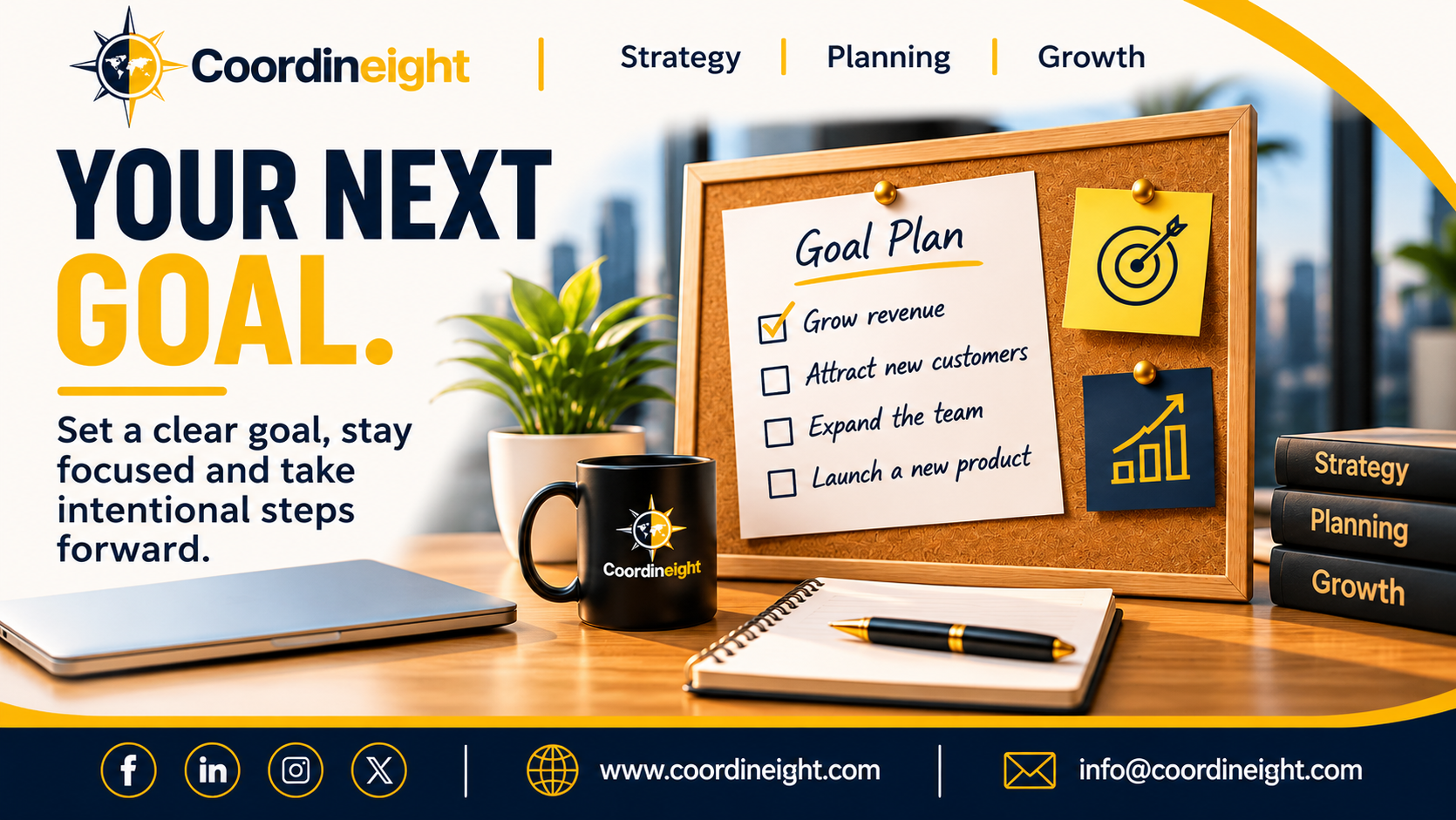
Every successful business journey begins with a clear sense of direction. Whether you want to increase revenue, attract new customers, expand your team, or launch a new product, establishing meaningful goals is an important step towards achieving your ambitions.
However, having a goal is not the same as having a strategy. Business success requires thoughtful planning, consistent action, effective resource management, and a willingness to adapt when circumstances change.
Without clear objectives, businesses can become distracted by competing priorities, making it difficult to measure progress or identify opportunities for improvement.
At Coordineight, we believe that intentional planning and focused execution are essential foundations for sustainable business development.
By identifying your next goal and taking deliberate steps towards achieving it, you can create a stronger foundation for long-term success.
Why Goal Setting Matters in Business
Business goals provide organisations with direction and help establish priorities. They allow business owners, managers, and employees to understand what they are working towards and how their individual efforts contribute to broader objectives.
Clear goals also support more informed decision-making. When businesses understand their priorities, they can evaluate opportunities, allocate resources, and develop strategies that align with their desired outcomes.
Benefits of Setting Clear Business Goals
- Improved focus: Concentrate time and resources on activities that support important business objectives.
- Better decision-making: Evaluate opportunities based on their contribution to your goals.
- Increased accountability: Establish clear responsibilities and expectations.
- Stronger team alignment: Help employees understand shared organisational priorities.
- Measurable progress: Track performance and identify areas requiring improvement.
- Greater adaptability: Recognise when strategies need to change.
- Sustainable growth: Develop a structured approach to business expansion.
A clear goal gives your business direction, while consistent action helps you move towards it.
1. Identify What You Want Your Business to Achieve
Before developing an action plan, take time to evaluate your current business position and identify what you want to accomplish next.
Different businesses have different priorities depending on their stage of development, available resources, market conditions, and long-term ambitions.
A newly established business may prioritise attracting its first customers, while an established organisation may focus on expanding into new markets or improving operational efficiency.
Common Business Goals
- Increase revenue and profitability.
- Attract new customers.
- Improve customer retention.
- Launch a new product or service.
- Expand into new geographical markets.
- Recruit additional employees.
- Strengthen brand awareness.
- Improve operational efficiency.
- Develop new strategic partnerships.
- Strengthen digital marketing performance.
Consider which objective would have the most meaningful impact on your business at its current stage.
Rather than attempting to pursue every opportunity simultaneously, identify priorities that align with your capabilities and long-term vision.
2. Use the SMART Goal-Setting Framework
One practical approach to developing effective business objectives is the SMART goal-setting framework.
SMART goals help transform broad ambitions into clearly defined objectives that businesses can work towards and evaluate.
What Does SMART Stand For?
- Specific: Clearly define what you want to achieve.
- Measurable: Establish indicators that allow you to track progress.
- Achievable: Ensure the goal is realistic based on available resources and capabilities.
- Relevant: Align the objective with your broader business strategy.
- Time-bound: Establish a deadline or timeframe for completion.
For example, instead of setting a general goal to increase sales, a business could establish an objective to increase monthly revenue by 15% within six months through customer acquisition and retention initiatives.
This provides a clearer target, an established timeframe, and a basis for developing an appropriate strategy.
The more clearly you define your goal, the easier it becomes to develop a practical plan for achieving it.
3. Evaluate Your Current Business Position
Effective goal setting requires an understanding of where your business currently stands.
Before committing to new objectives, assess your existing performance, available resources, operational capabilities, and potential challenges.
This process helps businesses identify realistic opportunities and understand what may be required to achieve their goals.
Questions to Guide Your Business Assessment
- What are our current business strengths?
- Which areas require improvement?
- What financial resources are available?
- What skills and capabilities exist within our team?
- What challenges could affect our progress?
- What opportunities exist within our market?
- Which existing activities are delivering the strongest results?
For example, a business planning to expand its customer base may need to review its marketing performance, sales processes, customer service capacity, and available budget.
Understanding these factors allows business owners to develop more informed and realistic growth strategies.
4. Break Large Goals Into Manageable Steps
Large business objectives can feel overwhelming when viewed as a single responsibility.
Breaking them into smaller milestones makes it easier to organise tasks, assign responsibilities, and monitor progress.
For example, launching a new product may involve several stages, including market research, product development, budgeting, testing, marketing preparation, and distribution planning.
Each milestone contributes to the completion of the larger objective.
How to Create an Actionable Goal Plan
- Define the main business objective.
- Identify the activities required to achieve it.
- Divide complex activities into smaller tasks.
- Assign responsibilities to relevant team members.
- Establish realistic deadlines.
- Identify resources needed for each stage.
- Schedule regular progress reviews.
Businesses can use project management platforms, spreadsheets, shared calendars, or simple planning documents to organise these activities.
The most effective planning system is one that the team can understand, maintain, and use consistently.
Small, intentional steps can create meaningful progress towards larger business ambitions.
5. Prioritise Activities That Support Your Goals
Business owners and teams often manage multiple responsibilities simultaneously. Without clear priorities, it can become difficult to distinguish between urgent tasks and activities that contribute to long-term growth.
Effective prioritisation involves evaluating how individual activities support your established objectives.
For example, if your primary goal is customer acquisition, improving your website, strengthening your marketing messages, and developing a structured sales process may deserve greater attention than activities with limited relevance to that objective.
Ways to Improve Business Prioritisation
- Identify activities with the greatest potential business impact.
- Separate essential responsibilities from optional activities.
- Establish daily, weekly, and monthly priorities.
- Delegate responsibilities where appropriate.
- Reduce unnecessary administrative work.
- Review commitments before accepting new responsibilities.
- Allocate dedicated time to strategic business development.
Maintaining focus does not mean ignoring new opportunities. It means evaluating those opportunities carefully before committing valuable time and resources.
6. Allocate the Right Resources
Achieving business goals requires more than motivation and ambition. Businesses must also ensure that appropriate resources are available to support their plans.
These resources may include funding, employees, technology, equipment, professional expertise, and sufficient time.
Understanding resource requirements early can help businesses identify potential limitations and avoid unnecessary operational pressures.
Key Resources to Consider
- Financial resources: Establish a realistic budget for planned activities.
- Human resources: Identify the people and skills required to complete tasks.
- Technology: Select digital tools that support efficiency and organisation.
- Time: Allocate sufficient time for planning, implementation, and evaluation.
- Professional support: Consider external expertise when internal capabilities are limited.
- Operational infrastructure: Ensure existing systems can support anticipated growth.
For example, a business seeking to expand its operations may need to consider additional staffing, improved internal systems, and increased customer service capacity.
Resource planning helps ensure that ambitious objectives are supported by practical capabilities.
7. Align Your Team With Shared Business Objectives
Business goals become more effective when employees understand what the organisation is trying to achieve and how their responsibilities contribute to that vision.
Without effective communication, different departments may pursue conflicting priorities or duplicate efforts.
Shared objectives help create greater coordination and accountability across the organisation.
How to Improve Team Alignment
- Communicate business goals clearly.
- Explain why each objective matters.
- Define individual roles and responsibilities.
- Establish clear performance expectations.
- Provide employees with appropriate resources and support.
- Encourage open communication and constructive feedback.
- Recognise individual and collective achievements.
Regular team meetings and progress updates can help employees remain informed about changing priorities, upcoming deadlines, and completed milestones.
When everyone understands the destination, it becomes easier to move forward together.
8. Use Digital Tools to Support Goal Achievement
Digital tools can help businesses organise activities, monitor performance, improve collaboration, and reduce time spent on repetitive administrative tasks.
However, technology should be selected according to business needs rather than simply following industry trends.
The objective is to create systems that make goal implementation more efficient and manageable.
Digital Tools That Can Support Business Goals
- Project management platforms: Organise tasks, responsibilities, and deadlines.
- Customer relationship management systems: Track customer interactions and sales opportunities.
- Analytics platforms: Monitor marketing performance and customer behaviour.
- Financial management software: Track expenses, budgets, and financial performance.
- Automation tools: Reduce repetitive administrative activities.
- Cloud-based collaboration platforms: Support document sharing and team communication.
- Digital calendars: Organise meetings, milestones, and important deadlines.
For example, a business focused on improving customer retention could use a customer relationship management system to track interactions, identify recurring concerns, and organise follow-up activities.
Appropriate digital tools can help businesses maintain visibility over their progress and make more informed decisions.
9. Measure Progress Using Relevant Performance Indicators
Monitoring progress allows businesses to understand whether their activities are contributing to established objectives.
Without appropriate measurement, it can be difficult to determine whether a strategy is working or whether adjustments are necessary.
Key performance indicators, commonly known as KPIs, provide measurable information about specific areas of business performance.
Examples of Business Performance Indicators
- Revenue growth: Monitor changes in business income over a defined period.
- Customer acquisition: Track the number of new customers gained.
- Customer retention: Evaluate how effectively the business maintains existing customer relationships.
- Conversion rate: Measure the proportion of prospects completing a desired action.
- Profit margin: Understand profitability relative to revenue.
- Project completion: Monitor the achievement of established milestones.
- Operational efficiency: Assess relevant measures of productivity and resource utilisation.
- Marketing performance: Evaluate engagement, enquiries, website traffic, and other relevant outcomes.
The most appropriate indicators depend on the nature of your objective.
For example, a business focused on customer retention may benefit more from monitoring repeat purchases and customer satisfaction than simply tracking social media follower growth.
Measure what matters to your goal, not just what is easy to measure.
10. Remain Flexible When Circumstances Change
Business environments are constantly evolving. Customer expectations, economic conditions, technological developments, and competitive pressures can influence the effectiveness of existing strategies.
Even carefully developed plans may require adjustments as new information becomes available.
Flexibility allows businesses to respond to changing circumstances without losing sight of their broader objectives.
How to Build Flexibility Into Your Business Strategy
- Review progress at regular intervals.
- Monitor changes in customer behaviour and market conditions.
- Encourage employees to identify emerging challenges.
- Maintain contingency plans for important activities.
- Evaluate alternative approaches when strategies are underperforming.
- Adjust timelines and resource allocations when necessary.
- Use performance data to guide strategic decisions.
Changing your approach does not necessarily mean abandoning your goal. In many situations, adapting your strategy is an important part of achieving it.
11. Celebrate Milestones and Maintain Momentum
Business growth often involves a series of smaller achievements rather than one significant breakthrough.
Recognising these milestones can help business owners and employees maintain motivation while acknowledging the progress already made.
Celebrating achievements also provides an opportunity to reflect on successful strategies and identify lessons that can support future objectives.
Meaningful Milestones to Recognise
- Reaching a revenue target.
- Securing a new customer or business partnership.
- Completing an important project.
- Successfully launching a product or service.
- Improving operational performance.
- Achieving a customer satisfaction milestone.
- Expanding into a new market.
- Developing new employee capabilities.
Recognition does not need to involve expensive celebrations. A team acknowledgement, internal announcement, or thoughtful message can help reinforce the value of collective effort.
Recognising progress encourages businesses to appreciate their achievements while continuing to work towards larger objectives.
12. Avoid Common Business Goal-Setting Mistakes
Setting business goals can provide valuable direction, but certain mistakes can make objectives more difficult to achieve.
Recognising these challenges early can help businesses develop more effective planning and implementation practices.
Common Goal-Setting Mistakes
- Setting vague objectives: Define clear and measurable outcomes.
- Pursuing too many goals: Concentrate on manageable strategic priorities.
- Ignoring resource limitations: Ensure objectives are supported by realistic capabilities.
- Failing to establish deadlines: Create clear timeframes for implementation.
- Overlooking team communication: Ensure employees understand their responsibilities.
- Neglecting performance measurement: Review progress and evaluate results regularly.
- Resisting change: Adapt strategies when circumstances require a different approach.
- Expecting immediate success: Recognise that sustainable growth requires consistent effort over time.
Effective goal setting is an ongoing process that involves planning, implementation, evaluation, and continuous improvement.
13. Connect Short-Term Goals With Your Long-Term Vision
While immediate objectives help businesses manage current priorities, long-term goals provide a broader sense of direction.
Connecting these two perspectives helps ensure that everyday activities contribute to the future you want to create for your business.
For example, a business with a long-term vision of becoming a recognised industry leader may establish shorter-term objectives relating to brand visibility, customer satisfaction, employee development, and service quality.
Each objective contributes to building the capabilities and reputation required to support the larger ambition.
Questions to Guide Long-Term Business Planning
- Where do we want our business to be in three to five years?
- What capabilities will we need to develop?
- Which markets or customer groups could support future growth?
- What investments should we prioritise?
- How can we strengthen our competitive position?
- Which short-term objectives will bring us closer to our long-term vision?
Long-term planning does not require businesses to predict every future development. It provides a strategic direction that can be refined as circumstances evolve.
Today’s business decisions should contribute to tomorrow’s opportunities.
14. Create a Practical 90-Day Business Goal Plan
A 90-day planning period can help businesses maintain focus while creating sufficient time to implement meaningful activities and evaluate their progress.
Rather than concentrating exclusively on annual objectives, businesses can establish shorter planning cycles that support continuous development.
Days 1–30: Establish Direction
- Identify your primary business goal.
- Evaluate current performance and available resources.
- Define measurable success indicators.
- Develop an action plan.
- Assign responsibilities and establish deadlines.
Days 31–60: Implement Your Strategy
- Complete planned activities.
- Monitor performance indicators.
- Review team progress regularly.
- Identify challenges and operational constraints.
- Adjust activities where necessary.
Days 61–90: Evaluate and Improve
- Compare actual performance against established targets.
- Identify successful activities and areas requiring improvement.
- Gather feedback from relevant stakeholders.
- Recognise completed milestones.
- Develop priorities for the next planning cycle.
This approach helps businesses maintain a balance between strategic planning and practical execution.
It also creates regular opportunities to reflect, learn, and make informed adjustments.
Your Next Goal Starts With Your Next Decision
Business success is rarely achieved through ambition alone. It requires clear objectives, thoughtful planning, consistent action, and the ability to adapt.
Whether your next goal is to increase revenue, attract more customers, expand your team, or introduce a new product, the decisions you make today can influence your future opportunities.
Take time to identify what matters most, develop a realistic strategy, and establish manageable steps that bring your business closer to its objectives.
At Coordineight, we believe that sustainable business growth begins with clarity, collaboration, and intentional action.
You do not need to achieve every objective at once. Focus on the next meaningful step and build momentum through consistent progress.
Set a clear goal. Stay focused. Take intentional steps forward.
Move Your Business Forward With Coordineight
Every business has opportunities to grow, improve, and develop new capabilities. Turning those opportunities into meaningful results begins with a clear understanding of your objectives and a practical approach to achieving them.
Whether you are developing your business strategy, strengthening existing operations, or preparing for your next stage of growth, intentional planning can help you move forward with greater confidence.
Connect with Coordineight to explore business development, strategic planning, and opportunities for sustainable growth.
Website: www.coordineight.com
Email: info@coordineight.com
Coordineight – Strategy. Planning. Growth.